

Machine learning is one of today's most disruptive technological trends. Its ability to analyze patterns and learn from data allows digital services to constantly evolve, offering much more personalized experiences. A clear example is the optimization of music recommendations in services like Google Play Music, where the system learns the user's tastes to refine their playlists. In fact, we recently analyzed Google's strategy with its context-based updates, demonstrating that the more we interact with the application, the more accurate the artificial intelligence becomes.
However, the potential of machine learning isn't limited to audio. Google has decided to apply this intelligence engine to a critical problem in the mobile era: image resolution . Currently, we face a paradox: while the screens of our devices (such as phablets or Smart TVs) demand increasingly higher resolutions to display sharp images, the internal memory of the devices and the speed of mobile networks act as a bottleneck. To resolve this conflict between quality and resource consumption, Google has developed an innovative technique called RAISR.
What is RAISR: Rapid and Accurate Image Super-Resolution?
RAISR, which stands for Rapid and Accurate Image Super-Resolution , is a cutting-edge technology that uses deep learning to generate high-quality versions of low-resolution images . Unlike traditional methods, RAISR doesn't simply stretch the image; it reconstructs lost details based on previously learned patterns.
The main advantage of this system is its efficiency. RAISR produces results that are comparable to, and in many cases superior to, existing super-resolution methods (known as SISR or Single Image Super-Resolution), but with a vast difference in speed: it improves processing time by 10 to 100 times . This speed is crucial, as it allows image enhancement to be performed in real time directly on the user's device, without the need to process the image on an external server and wait for a response.
In addition to sharpness, RAISR solves annoying visual problems. In the near future, this technique will allow the complete elimination of aliasing artifacts , as well as moiré patterns, which often appear when attempting to enlarge a low-quality image, returning a clean image, free of halos and digital noise.
The difference between traditional upsampling and RAISR
To understand the technological leap that RAISR represents, we must analyze the upsampling method that has been used for years. Traditional upsampling is based on linear methods: basically, the system takes the existing resolution and "stretches" it, filling the gaps of the new pixels by combining the values of the surrounding pixels.
Although this process is extremely fast because it uses simple linear filters, it has a serious drawback: it's unable to recreate vivid details . The result is an image that, even when enlarged, appears blurry, pixelated, or with artificially smoothed edges, because the software doesn't "understand" what the image is representing; it only calculates mathematical averages of color.

How the RAISR process technically works
The secret of RAISR lies in its training. Unlike a static filter, RAISR uses machine learning by analyzing pairs of images : a high-resolution version (the original) and a low-resolution version of the same photograph. Through this comparative analysis, the AI discovers which elements are lost during the reduction process and learns to synthesize them again.
RAISR training can be done in two different ways:
- Direct Method: Reconstruction filters are learned directly by comparing the pair of low and high resolution images.
- Indirect Method: A filter similar to that of a traditional "upsampler" is first applied to the low-resolution image, and then the AI learns the filters needed to close the gap between that intermediate result and the original high-quality image.

Regardless of the method, RAISR filters are trained to recognize specific characteristics of "peaks" in small patches of the image. This includes the ability to distinguish between color gradients, areas of intense brightness, regions with complex textures, or flat areas. The AI evaluates the direction, strength, and consistency of each pixel to apply the most appropriate solution.
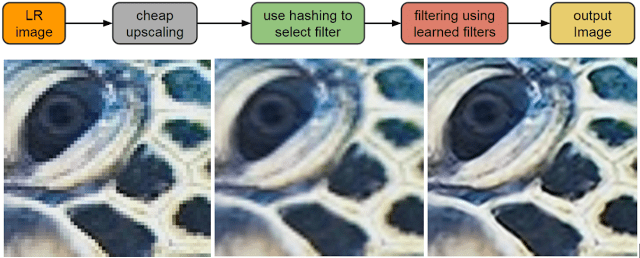
In real time, the system selects and applies the most relevant filters from its learned database to each neighboring pixel. The end result is an image that recreates details comparable to the original , eliminating the pixelated look and dramatically improving visual sharpness.
Real impact: Data and bandwidth savings
The most disruptive application of RAISR is not just the aesthetic improvement, but the massive resource savings . By allowing a very low-resolution image to appear as high-quality, Google can transmit much smaller files without the user noticing the difference.
This development has direct implications for the mobile user experience:
- Reduction of data consumption: It is estimated that RAISR can reduce the weight of an image by up to 75 %This means that with the bandwidth needed to download a single standard image, the user could upload four RAISR-processed images.
- Storage optimization: Photos could be saved in lower resolutions to save space in the cloud or internal memory, being enlarged only at the time of viewing.
- "Pinch to Zoom" Improvement: The pinch-to-zoom function on the phone becomes smoother and sharper, as AI can generate the necessary resolution on the fly.
- Faster app loading: Less data means shorter loading times, improving the performance of apps that rely heavily on images.
Implementations and future of technology
Google has already begun integrating RAISR into various services. One of the most notable implementations has been in the Google+ app , where the system has been used to serve billions of images weekly, achieving a significant reduction in bandwidth for millions of users. The technology has also been applied to the Motion Stills app for iOS, improving the sharpness of videos exported from Live Photos.
The growth potential is almost limitless. It's very likely we'll see RAISR evolve into services like Google Photos , allowing not only optimized storage but also the recovery of quality from old photos taken with outdated devices (like the old, low-resolution Nokia phones) that now appear pixelated on modern screens. Furthermore, its application in YouTube thumbnails or the Google Play Store would make navigation instantaneous without sacrificing visual quality.
Unlike traditional JPG compression, which removes information and creates visual artifacts to reduce file size, RAISR doesn't compress the image in the classic sense. Instead, it reduces its physical size and relies on artificial intelligence to predict and reconstruct the missing information. While it can't always predict every detail with mathematical precision, the result is so visually convincing that it fools the human eye into believing it's the original high-resolution image.
This advancement represents a paradigm shift in multimedia content management. By shifting the workload from data transfer (downloading) to local processing (on-device computing), Google makes internet browsing more efficient, cost-effective, and visually appealing, ensuring that image quality is not a limitation in the mobile era.
Table of Contents