

When you buy a new Android phone, it will most likely come loaded with several pre-installed apps. Some of these might be useful, but in most cases, they include programs you don't need that take up space, slow down your device, or that you'll simply never use. These types of apps are commonly known as bloatware . However, removing these pre-installed Android apps without root access is a separate issue that requires knowing the right tools to avoid compromising the device's stability.
Removing bloatware might seem like a complicated task , especially without root access, but there are actually several ways to get rid of pre-installed apps without too much hassle. If you want to know how, this article will explain the different methods step by step, from the simplest options to the most powerful technical techniques.
What exactly is bloatware and what do you gain by removing it?

The term bloatware originated in the world of computers to refer to programs that take up a lot of space or consume a lot of resources. In the case of Android, bloatware refers to those often useless applications that come pre-installed on devices and that usually take up space or slow down the system. These apps can come from the manufacturer (such as Samsung, Xiaomi, or Motorola), the mobile carrier , or, in some cases, be promotional apps from third-party companies.
Unlike on a computer, where you can often easily uninstall this type of software , on Android some system or pre-installed apps cannot be removed so easily, which can be frustrating. This is because these apps reside on a system partition separate from the user data partition, protecting them from accidental deletion.
It's important to understand that when removing bloatware without root access, the original APK file usually remains in the system partition, so the recovered storage space may not be massive. However, the benefits are real: you eliminate the space occupied by updates , data, and cache. Furthermore, you prevent these apps from running background processes, resulting in improved battery life , faster processor response, and a much cleaner and more organized app drawer, eliminating annoying duplicates like having two calendars or two photo galleries.
How to remove pre-installed apps on Android without root
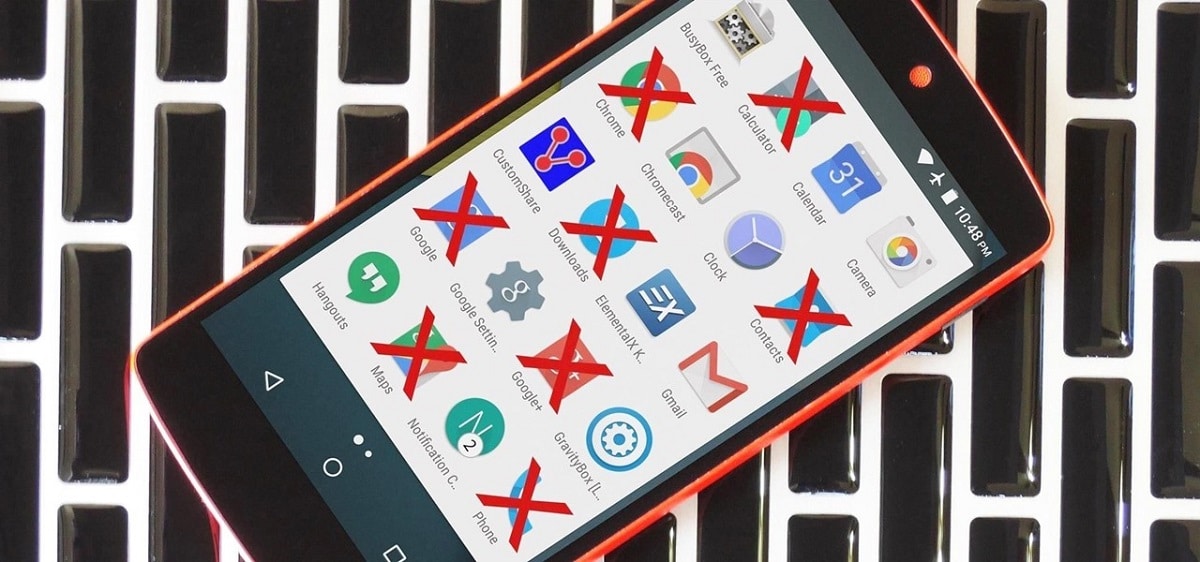
The process for removing pre-installed apps on Android varies depending on the app and device. One key point is understanding that there are different levels of removal. Some apps can be uninstalled directly , others can only be disabled , and still others require external tools like ADB or Shizuku . Here's a detailed explanation of each method.
Check if they can be uninstalled in the traditional way
Before resorting to complex methods, check if the app can be removed in the usual way. Surprisingly, some third-party Google apps or apps included through manufacturer partnerships are optional and can be easily removed.
To uninstall an app in the conventional way:
- Hold down the application icon on the home screen or the app drawer.
- Check if the option appears uninstall.
- If your launcher doesn't display this menu, go to Settings> ApplicationsSelect the app and check if the uninstall button is active.
This method is the safest and most reversible, since you can reinstall the application from the Google Play Store at any time.
Disable system applications

If the uninstall option isn't available, you can probably disable it . Disabling an app stops it from running in the background, removes it from the app drawer, and deletes its data and updates. Even if the APK file remains on the system, the app is completely deactivated , preventing it from consuming CPU, RAM, and battery.
Follow these steps to disable an app:
- Sign in Settings on your device.
- Access the section of Applications.
- Select option See all applications.
- If you don't see the app you're looking for, tap the three-dot menu (⋮) and activate Show system.
- Select the application and tap Disable (or Deactivate). Confirm the action.
The great advantage of this method is that it's completely reversible . If you notice that any function on your phone stops working correctly, you can re-enable the app from the same menu.
Uninstall pre-installed applications using ADB (Android Debug Bridge)
For more persistent apps that don't allow uninstallation or disabling, the solution is to use ADB (Android Debug Bridge) . This method allows you to "uninstall" packages for user 0 (the main profile). Technically, the app still exists in the system partition, but it's invisible and null to the user, which is equivalent to a deep cleanup without requiring root access.
Preparing the device and computer:
- Enable Developer Options: Go to Settings> About phone and press seven times on it Build Number until the system notifies you that you are now a developer.
- Enable USB Debugging: Enter the new menu Developer Options and activate the box USB debugging.
- Install ADB: Download the Platform-Tools Download the official Google files to your PC (Windows, macOS or Linux) and extract them.
- Connect your mobile device: Use a quality USB cable and, when the notification appears on your mobile phone screen, authorizes the RSA fingerprint of the computer.
Command execution:
Open a terminal (CMD or PowerShell on Windows, Terminal on Mac/Linux) within the ADB folder and verify the connection with:
adb devices
To delete an application, you first need to know the package name (ex. com.google.android.youtubeOne trick is to search for the app in the Play Store from a browser; the package name appears in the URL after id=Once identified, use the following command:
adb shell pm uninstall -k --user 0 package_name
If you change your mind and want to recover the app without downloading anything, use the command:
adb shell cmd package install-existing package_name
Using Universal Android Debloater (UAD) and ADB AppControl

If the terminal seems intimidating to you, there are graphical tools that act as a bridge to ADB, greatly simplifying the task.
Universal Android Debloater (UAD): This free and open-source tool is available for Windows, Mac, and Linux. Its main advantage is that it categorizes applications according to their risk. It tells you which apps are safe to remove, which are for advanced users, and which should never be touched to avoid rendering your phone unusable. Simply connect your phone, select the apps, and click Uninstall.
ADB AppControl: This is a powerful alternative for Windows users. It allows you to not only uninstall or disable apps, but also manage APKs, clear data, and filter applications by size or name. It offers a modern and visual interface that makes the debloating process much more intuitive.
PC-free method: Shizuku and Canta
For those without a computer, there's an innovative combination based on Shizuku and Canta . This method is compatible with Android 9.0 or later.
Shizuku is an application that allows other apps to use system APIs with elevated permissions through wireless debugging, without requiring root access. Canta is the tool that uses the Shizuku bridge to manage bloatware.
Steps to configure it:
- Install Shizuku Download it from the Play Store and activate it following its instructions (requires enabling wireless debugging in developer options and pairing a code).
- Install Canta (available on GitHub or F-Droid).
- Grant Canta the necessary permissions and link the app to Shizuku.
- Browse the list of applications. Sing uses risk labels (Recommended, Advanced, Expert, Not Recommended). Select the safe apps and tap the trash can icon.
As with ADB, Canta keeps a record of removed applications, allowing you to easily reinstall them if you detect any system failures.
Remove pre-installed apps with root permissions

If you have root access , you have absolute control. Unlike the previous methods, root allows you to physically delete the APK file from the system partition. This means the application disappears completely from the device, not just for the current user.
You can use tools like App Remover or Root Uninstaller . These apps allow you to select any package and permanently delete it. However, this method is the riskiest:
- Irreversibility: If you delete a critical system app, you won't be able to recover it with a simple command; you'll need to reinstall the ROM or have a full backup.
- Instability: Removing components from the Android framework can cause bootloops (the mobile phone restarts infinitely) or failures in basic functions such as telephony or notifications.
- Warranty: Rooting the device generally voids the manufacturer's warranty.
If you decide to use root, it is imperative to make a backup (Nandroid Backup) before proceeding.
Considerations, warnings and best practices

Modifying the operating system always carries a risk. To optimize your phone safely, follow these guidelines:
- Prioritize what is reversible: Always start with the traditional uninstallation, then disabling, and as a last resort, ADB or Shizuku.
- Investigate the package: Don't delete anything based solely on the name. Search forums like XDA Developers or use the descriptions from Universal Android Debloater to find out exactly what the package does.
- Beware of Google Services: Avoid removing Google Play Services or Google Services Frameworkbecause most apps on the Play Store will stop working.
- Don't touch the Launcher: If you remove the system launcher (the home screen) without having installed another one beforehand, you could get stuck on a black screen without being able to access the settings.
- System Updates: Keep in mind that after a OTA update Or a factory reset; system apps are usually reinstalled automatically. You'll need to repeat the cleanup process.
Common practical scenarios
Case 1: Remove YouTube or Google Photos. If you prefer to use alternatives like NewPipe or a simple gallery, you can use ADB with pm uninstall -k --user 0 com.google.android.youtubeThe app disappears and the system feels lighter.
Case 2: Operator apps. Apps from Movistar, Vodafone, AT&T, etc., are perfect candidates for removal, as they rarely affect system stability and are usually purely for advertising purposes.
Case 3: The "Disable" button is grayed out. Some manufacturers block this option for their own apps. In this case, ADB AppControl or Canta are the only non-root solutions to force the deactivation.
Removing pre-installed Android apps isn't impossible, and there are methods for every type of user. From the simplicity of disabling an app in Settings, to the power of ADB and tools like Universal Android Debloater or ADB AppControl, to Shizuku and Canta's mobile solution, there's always a way to clean up your device. For those seeking total control, rooting offers physical removal, albeit with greater risks. The key is to proceed with caution, research each package, and prioritize reversible methods to maintain your phone's stability and warranty while optimizing performance and privacy.
Table of Contents